Changing how businesses interact with user data
The digital revolution is producing increasingly large amounts of user data. And while its value is enormous it is still the Wild West in the digital consumer-business relationship: little trust, no transparency and every opportunity to get data is used as if it's the last.
The new regulation (such as GDPR) tries to set some ground rules, but legislation will always lag behind the IT progress. Instead we need a transparent technology that will bring order into business-user personal data exchange - the trust layer.
Altos changes the way personal data is shared on the web. It's a communication layer that guarantees that the user's data can be trusted, while the user keeps control of his privacy.
Use cases
Exploring the power of trustful relationships
One click content personalization for users
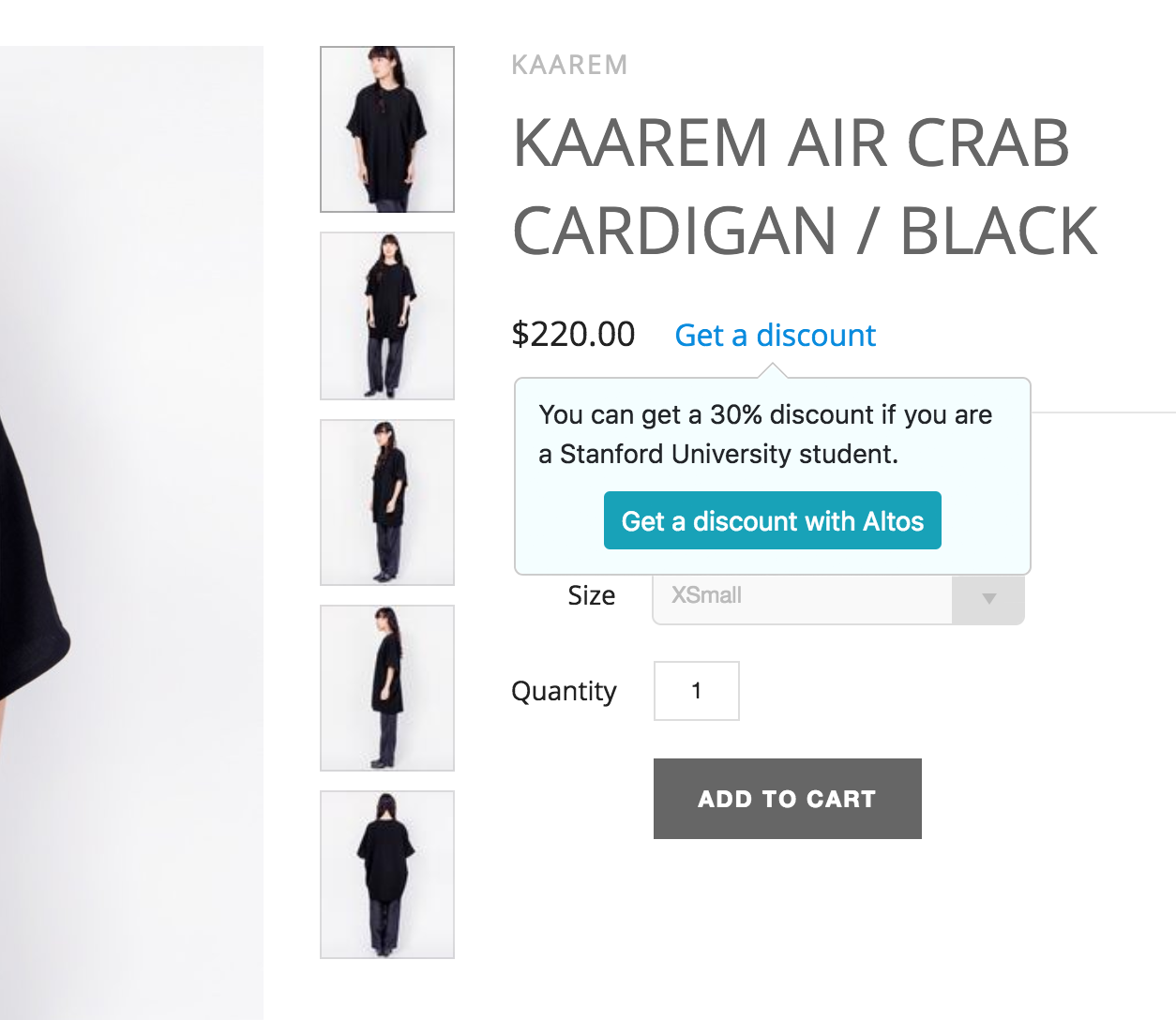
In today's world companies use cookies to track users across the internet to customize the online experience. That leads to the abuse of privacy and the use of mediocre data. Altos allows websites to ask for the user's permission to retrieve exactly the data they need.
Example: an ecommerce website offers a 30% discount to verified Stanford university students (done with only a few lines of JavaScript).
Fast form completion with reliable data
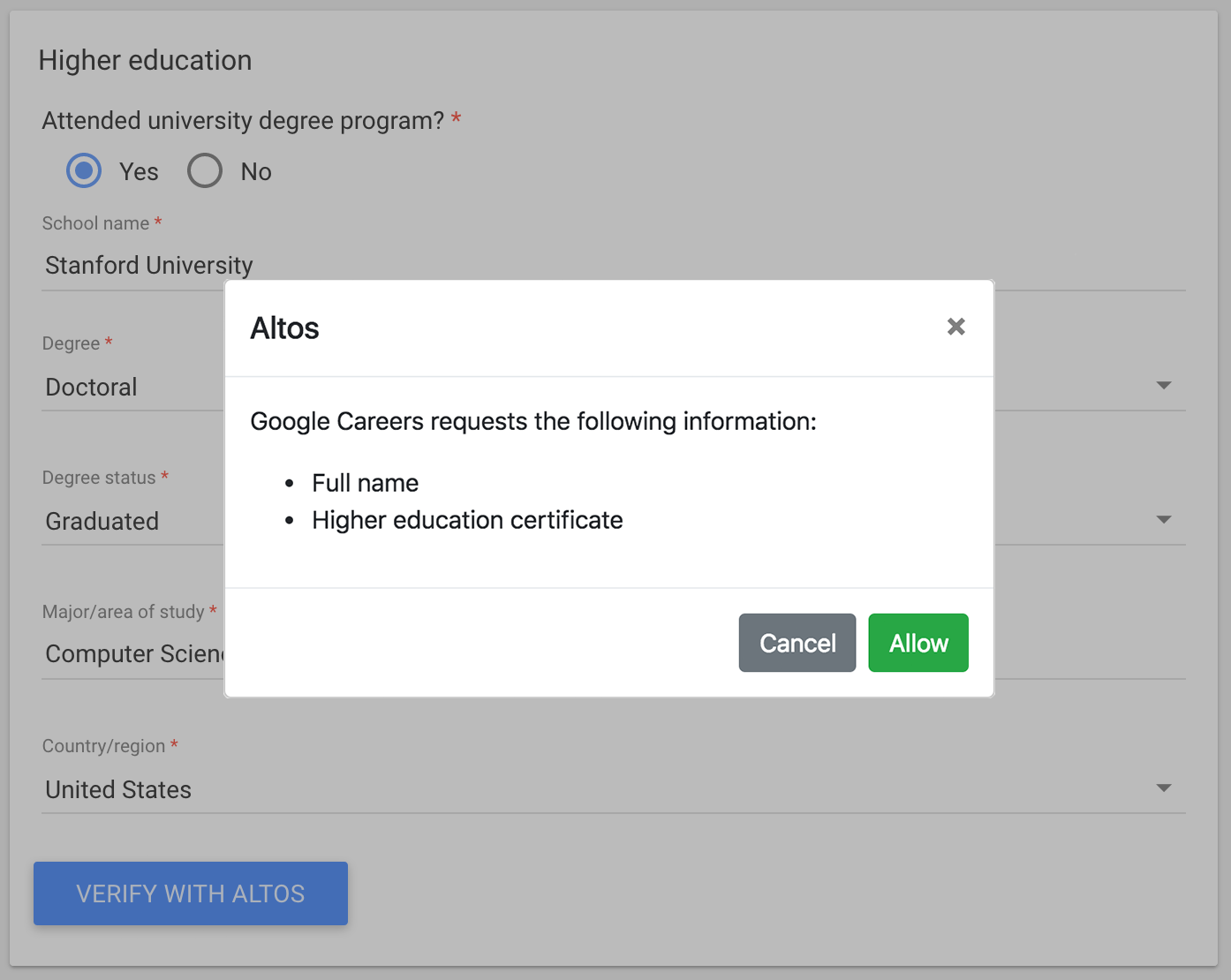
Online forms is an endless source of unreliable data, so we spend hours in interviews and document requests to verify provided information. Altos unleashes the power of personal data and allows to complete forms in one click with information that can be trusted.
Example: a user applying for a job can easily provide a digital proof of his education and work experience without sharing any sensitive details.
Publish cryptographic fact proof on the web
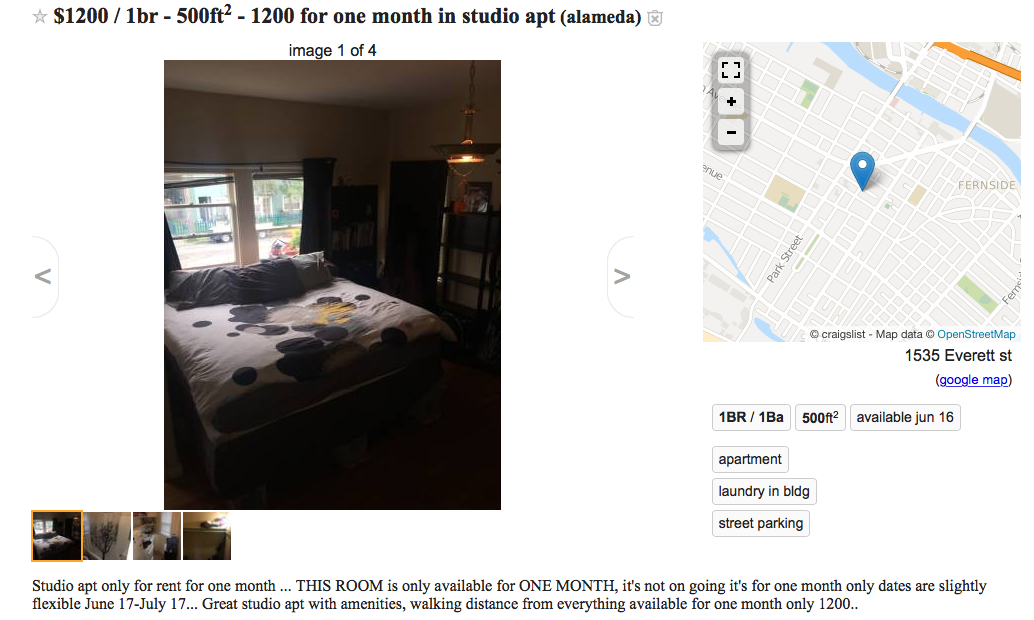
Internet is full of claims: someone owns a property you are about to rent, someone graduated from a university, an e-commerce company website is owned by a legitimate business, a newly released app has 1 million users. However, most of these claims are hard to verify and we have to take one's word for it. Altos makes it possible to turn a digital evidence of these claims into cryptographically signed proofs and earn trust in seconds.
Example: when you are about to rent a property found on craigslist the listing provides a proof that the person owns the house without revealing any private details.
Next-gen companies with transparent data handling
Today online companies claim that they act in the best interest of the users. However, their incentives are often aligned differently and there is no way to be sure what happens to your data and how it is used. The next generation of businesses will be more transparent about data processing and will put the critical parts of their systems into trusted compute environments.
Example: Kayak uses undisclosed techniques to sell airplane tickets - sorting search results, posting misleading calls to action. "Kayak 2.0" will keep the critical parts of flight search technology transparent, earning user's trust and complying with regulation.

Trusted "can't-be-evil" compute infrastructure
Decentralized governance for computations on private data
1. Reviewed open source code
All code that processes personal user data is open sourced and thoroughly reviewed by the blockchain-powered governance board. Each new code version is checked against security issues and data leaks before it can be deployed.
2. Continuously audited infrastructure
Each compute container is sealed when it's set up so that no one can ssh into it. Every few minutes all logging information and state of the infrastructure is verified. In case of any suspicious activity the container is excluded from the trusted list.
3. Transparent decentralized governance
Altos exercises a full organizational transparency. The blockchain-powered governance board comprised of reliable independent parties will make sure our job is done well and have enough power to prevent any abuse. As a result the trust layer of the web will not be controlled by a single organization.
Building trust in data
Prove selected facts about your data without showing it
1. Use quality data from reliable sources
Data is extracted from various sources (such as digital documents, social media accounts). It is always signed cryptographically and thus can be trusted by the recipient.
2. Extract structured facts from raw data
Data is only as useful as its representation. Based on a custom-built ontology of facts we extract information from unstructured data using advanced NLP and AI techniques. All data is processed in a trusted secure compute environment, that erases all data traces upon completion.
3. Create cryptographic fact proof without revealing the original data
Frequently, proving something comes at the cost of sharing all related documents. To preserve user privacy Altos uses zero knowledge proofs to make facts trustworthy while preventing the rest of the data from exposure.
Private data sharing
The system designed so that even Altos team can't access personal user data
1. Complete control over data
User privacy is our key priority. The user always explicitly grants access to the personal data and no one can read it without a permission. Period.
2. Personalization
By making it easy to integrate data request and sharing into existing web and mobile apps Altos makes the new level of personalization possible. Instead of using tracking cookies and shady data collection techniques websites can ask user to share relevant data in one click.
3. Regulatory compliance
Our technology is aligned with GDPR and other legal frameworks protecting digital rights of users. Altos provides a technological protection against abuse of control over data flow. That could be used among future regulation approaches to shift from legislative to technological enforcement.
Team

Pavel Izhutov
Stanford Business School PhD '17 in Operations, Information and Technology. Part-time hacker. Blockchain enthusiast since 2014

Sergey Kopylov
PhD in Theoretical Physics from Lancaster University, UK. Have been CTO in multiple startups for the last 10 years. Website